

There is clear evidence-based research that has been published in scholarly and scientific journals demonstrating the proven success of the clubhouse model.
Here is a sampling of recent research in this area.
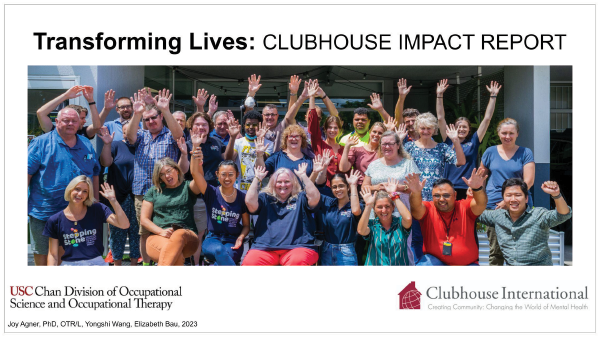
“Clubhouse Model and Its Impact on Psychiatric Hospitals in Canada: A Cohort Study.” Russell, Lifeso, Fazio, et. al. (2021) Canadian Journal of Community Mental Health, Vol. 40, No 3, 2021
“Analysis of the Association of Clubhouse Membership with Overall Costs of Care for Mental Health Treatment.” Hwang, Woody, Eaton. Community Mental Health Journal DOI 10, 1007s, 1592016-0041-3
McKay, Nugent, Johnsen, et.al., (2018) A “Systematic Review of Evidence for the Clubhouse Model of Psychosocial Rehabilitation” Administration and Policy in Mental Health and Mental Health Services Research. link.springer.com, 45: 28-47
“Fountain House and Use of Health Care Resources.” Grinspan, Zachary. 2015, WCMCHPR Brief Research Report, May, 2015
“Family Perceptions of Clubhouse Community Programs,” Family Relations.” 64, July 2015, 446-459, DOI 10,111/fare.12127 Pernice-Duca, Biegel, Hess, et.al.
“Family Members Perceptions of How They Benefit When Relatives Living With Severe Mental Illness Participate in Clubhouse Community Programs. A Systematic Review of Evidence For the Clubhouse Model of Psychosocial Rehabilitation.” McKay, Nugent, Johnsen, et.al. (2018) Administration and Policy in Mental Health and Mental Health Services Research. 24, 28-47
Tanaka, K., (2013) “Clubhouse Peer Support Among Individuals With Psychiatric Illness.” International Journal of Self Help and Self Care, 7: 131-149.
Tanaka, K. Craig, T. & Davidson, L., (2015) Clubhouse Community Support for Life: Staff-Member Relationships and Recovery.” Journal of Psychosocial Rehabilitation and Mental Health. 2, 131-141.
Learn more about the success of the Clubhouse model from firsthand accounts and testimonials